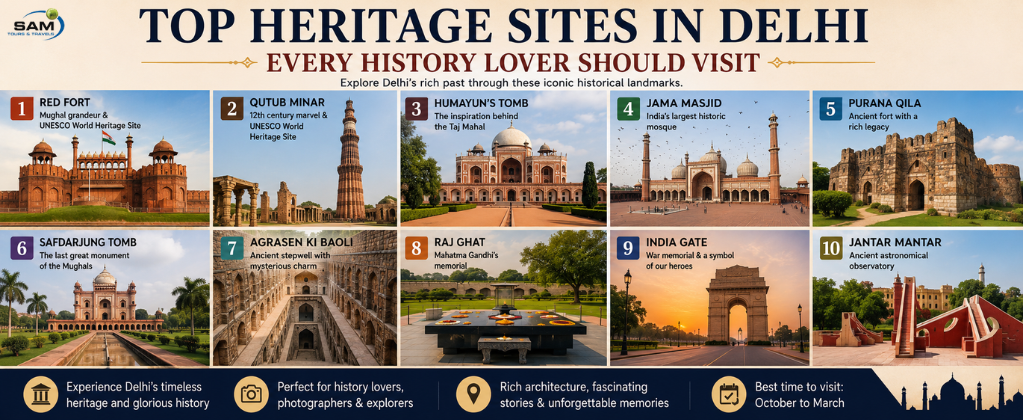
Delhi is a living museum where centuries of history come alive through magnificent forts, grand tombs, ancient mosques, and architectural wonders. As one of the oldest continuously inhabited cities in the world, Delhi has been the capital of several powerful dynasties, including the Delhi Sultanate, Mughals, and British Empire. Today, the city boasts an incredible collection of heritage sites that attract history enthusiasts from around the globe.
If you’re passionate about history, culture, and architecture, here are the top heritage sites in Delhi that deserve a place on your travel itinerary.
1. Red Fort – The Symbol of Mughal Grandeur
The Red Fort is one of Delhi’s most iconic landmarks and a UNESCO World Heritage Site. Built by Mughal Emperor Shah Jahan in 1648, this magnificent red sandstone fort served as the main residence of the Mughal rulers for nearly 200 years.
Highlights:
- Lahori Gate
- Diwan-i-Aam
- Diwan-i-Khas
- Rang Mahal
- Sound and Light Show
The fort’s impressive architecture and rich history make it a must-visit destination for every history lover.
2. Qutub Minar – Delhi’s Tallest Historical Monument
Standing at 73 meters, Qutub Minar is the tallest brick minaret in the world and another UNESCO World Heritage Site. Constructed in the 12th century by Qutb-ud-din Aibak, it marks the beginning of Muslim rule in India.
Highlights:
- Five-story minaret
- Intricate carvings and inscriptions
- Quwwat-ul-Islam Mosque
- Iron Pillar
The monument offers a fascinating glimpse into Delhi’s medieval history and architectural evolution.
3. Humayun’s Tomb – The Inspiration Behind the Taj Mahal
Built in 1570, Humayun’s Tomb is considered one of the finest examples of Mughal architecture. It was the first garden tomb in India and later inspired the design of the Taj Mahal.
Highlights:
- Persian-style gardens
- Stunning red sandstone architecture
- Symmetrical design
- Historical significance
The peaceful surroundings and beautiful architecture make it one of Delhi’s most photographed heritage sites.
4. Jama Masjid – India’s Largest Historic Mosque
Commissioned by Shah Jahan in 1656, Jama Masjid remains one of the largest and most magnificent mosques in India.
Highlights:
- Massive courtyard
- Three grand gates
- Beautiful marble domes
- Panoramic views of Old Delhi
Visitors can climb the southern minaret for breathtaking views of the bustling city below.
5. Purana Qila – Delhi’s Ancient Fort
Purana Qila, or the Old Fort, is believed by many historians to stand on the site of the legendary city of Indraprastha mentioned in the Mahabharata.
Highlights:
- Ancient fort walls
- Qila-i-Kuhna Mosque
- Sher Mandal
- Archaeological Museum
The fort provides valuable insight into Delhi’s early history and medieval architecture.
6. Safdarjung Tomb – The Last Great Mughal Monument
Built in 1754, Safdarjung Tomb represents the final phase of Mughal architecture before the decline of the empire.
Highlights:
- Beautiful Mughal gardens
- Ornate mausoleum
- Intricate stonework
- Peaceful atmosphere
Although less crowded than other monuments, it offers remarkable architectural beauty.
7. Agrasen Ki Baoli – Delhi’s Hidden Historical Gem
This ancient stepwell is one of Delhi’s most intriguing heritage attractions. Though its exact origins remain uncertain, the structure is believed to date back several centuries.
Highlights:
- 108 stone steps
- Unique architecture
- Historic water reservoir
- Popular photography location
Its mysterious charm and unique design attract both history lovers and photographers.
8. Raj Ghat – Memorial of Mahatma Gandhi
Raj Ghat marks the cremation site of Mahatma Gandhi, the Father of the Nation.
Highlights:
- Black marble memorial
- Eternal flame
- Beautiful gardens
- Peaceful surroundings
It serves as a place of reflection and remembrance for visitors from around the world.
9. India Gate – A Colonial-Era Landmark
Although relatively modern compared to Delhi’s Mughal monuments, India Gate is an important historical site built in memory of Indian soldiers who lost their lives during World War I.
Highlights:
- War memorial
- Amar Jawan Jyoti
- Evening illumination
- Popular public gathering spot
The monument remains one of Delhi’s most recognized landmarks.
10. Jantar Mantar – An Ancient Astronomical Wonder
Built in 1724 by Maharaja Jai Singh II, Jantar Mantar is an astronomical observatory that showcases India’s scientific achievements during the 18th century.
Highlights:
- Giant astronomical instruments
- Sundials
- Historical scientific innovations
- Educational exhibits
It offers a unique perspective on India’s contributions to astronomy and mathematics.
Best Time to Explore Delhi’s Heritage Sites
The ideal time to visit Delhi’s historical monuments is between October and March when the weather is pleasant and comfortable for sightseeing.
Travel Tips:
- Start early in the morning.
- Wear comfortable walking shoes.
- Carry water and sunscreen.
- Hire a knowledgeable guide for deeper historical insights.
- Consider a heritage tour package to cover multiple attractions efficiently.
Why Delhi is a Paradise for History Lovers
Few cities in the world offer the historical diversity found in Delhi. From ancient forts and Mughal masterpieces to colonial landmarks and modern memorials, the city presents a remarkable journey through more than a thousand years of history.
Whether you’re fascinated by Mughal architecture, medieval dynasties, ancient legends, or colonial heritage, Delhi provides endless opportunities for exploration and discovery.
A visit to these heritage sites will not only enrich your understanding of India’s past but also leave you with unforgettable memories of one of the world’s most historic capitals.